
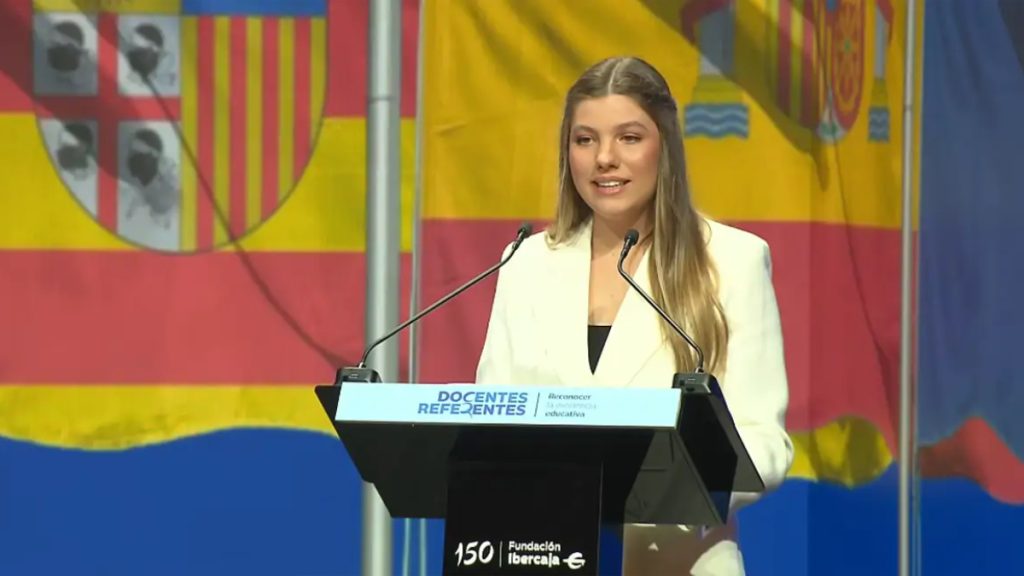
Expectations were high, and Infanta Sofia did not disappoint. This week, at the Monastery of Our Lady of Cogullada in Zaragoza, the youngest daughter of the King and Queen made her debut as a speaker, delivering her first solo institutional address on the occasion of the presentation of the Ibercaja Foundation’s “Docentes Referentes” grants.
Dressed in a white oversized suit with a jacket and pants, she took the stage, visibly nervous – which is understandable for any debut. However, what came out of her mouth surprised everyone with its maturity and approachability.
Her parents arrived alongside her and her sister Leonor, and that family support was also evident at the end, when they rushed to hug her amid applause.
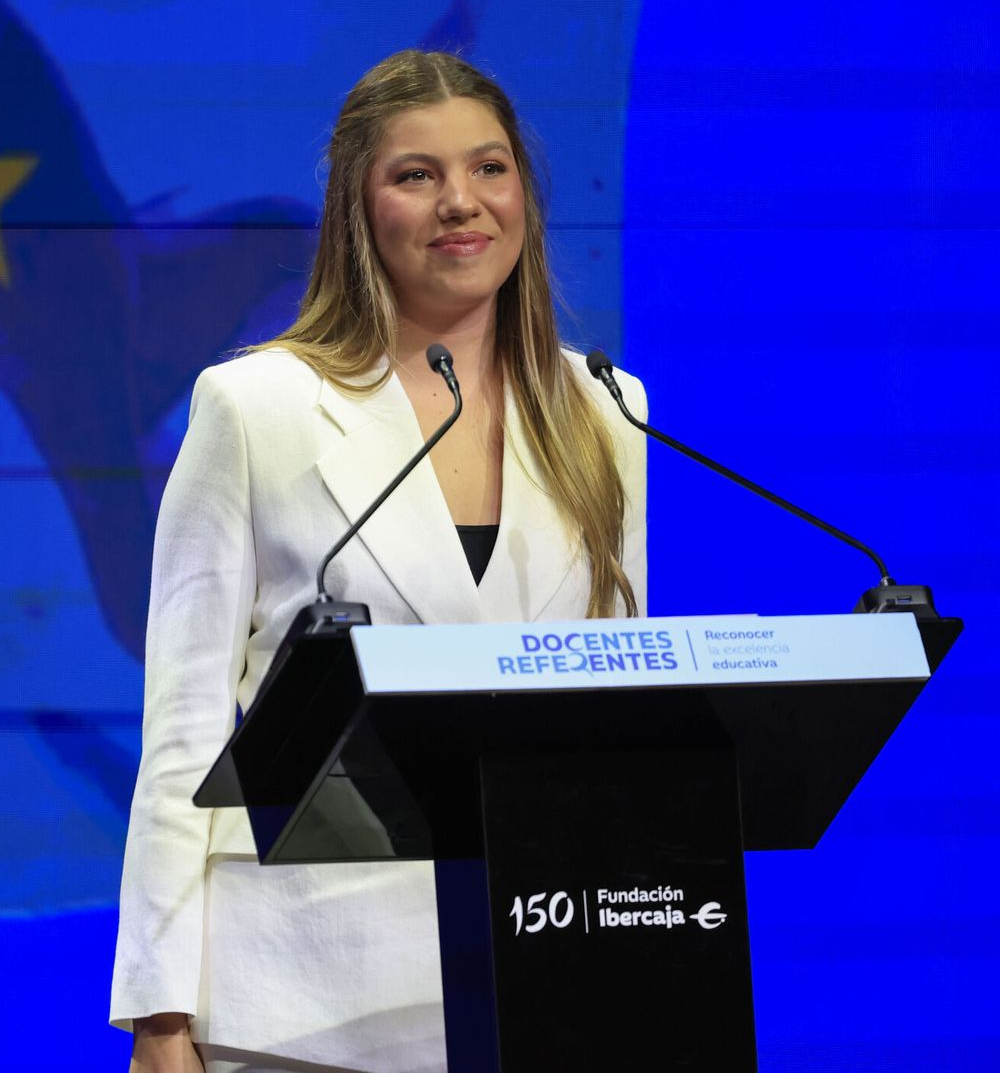
What did Infanta Sofia share about her childhood in her speech?
The first thing she did was evoke nostalgia. She recounted that at the age of eight, during a typical Sunday movie afternoon at home, she discovered the Iranian film Buddha Exploded with Shame, and that the story left a lasting impression on her. In the film, she met Baktay, a six-year-old Afghan girl who was trying to trade some eggs for a half-torn notebook just so she could go to school.
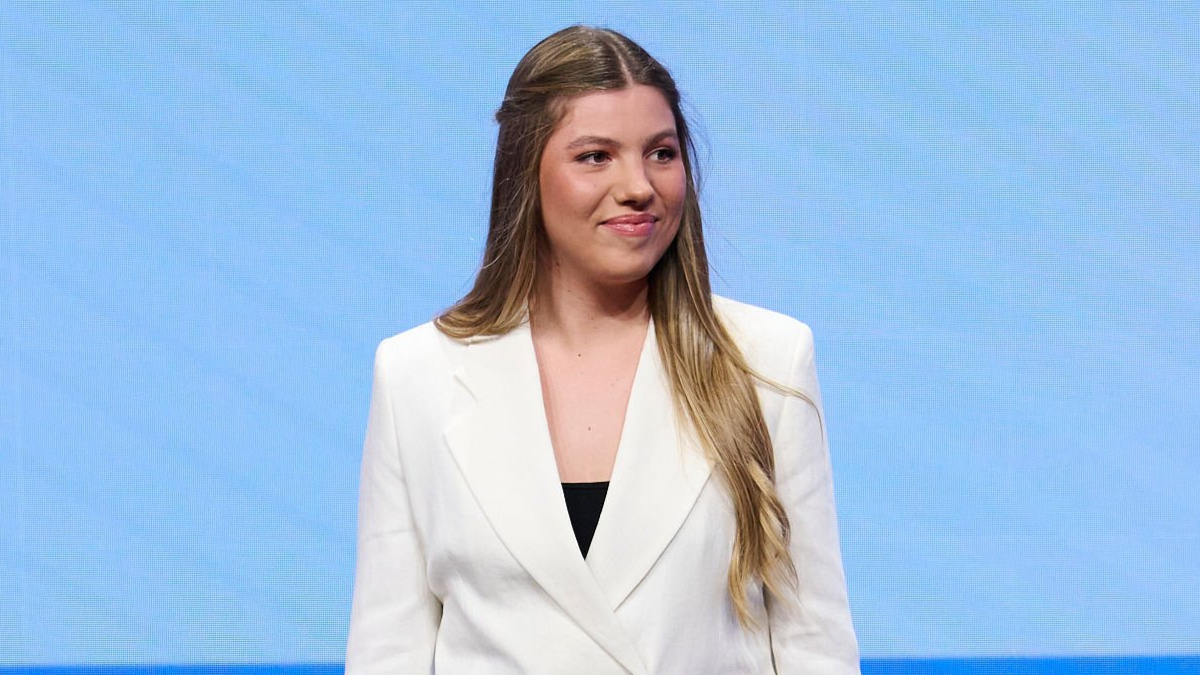
Sofia explained that the girl faced “a whole universe that denied her the right to learn, to knowledge,” and confessed that, although at the time she didn’t fully understand the reality of Afghanistan, that courage stayed with her for years, even helping her go to her third-grade class with renewed enthusiasm.
What did Infanta Sofia say about the challenges facing education in Spain?
From that point on, her speech took on a much more activist tone. The Infanta didn’t limit herself to anecdotes; instead, she bluntly listed the challenges facing the educational community today: bullying, a loss of authority, disputed salaries, dropping out of school, classroom sizes, a lack of support for students with special needs, excessive bureaucracy, and funding.
She chose not to delve into technical debates like AI in the classroom or digital literacy. Instead, she focused on the human connection, that moment in childhood when a teacher says something that remains etched in a student’s memory forever. She also quoted scientist Carlos López Otín, who summed up the art of education in three words: respect, curiosity, and commitment.
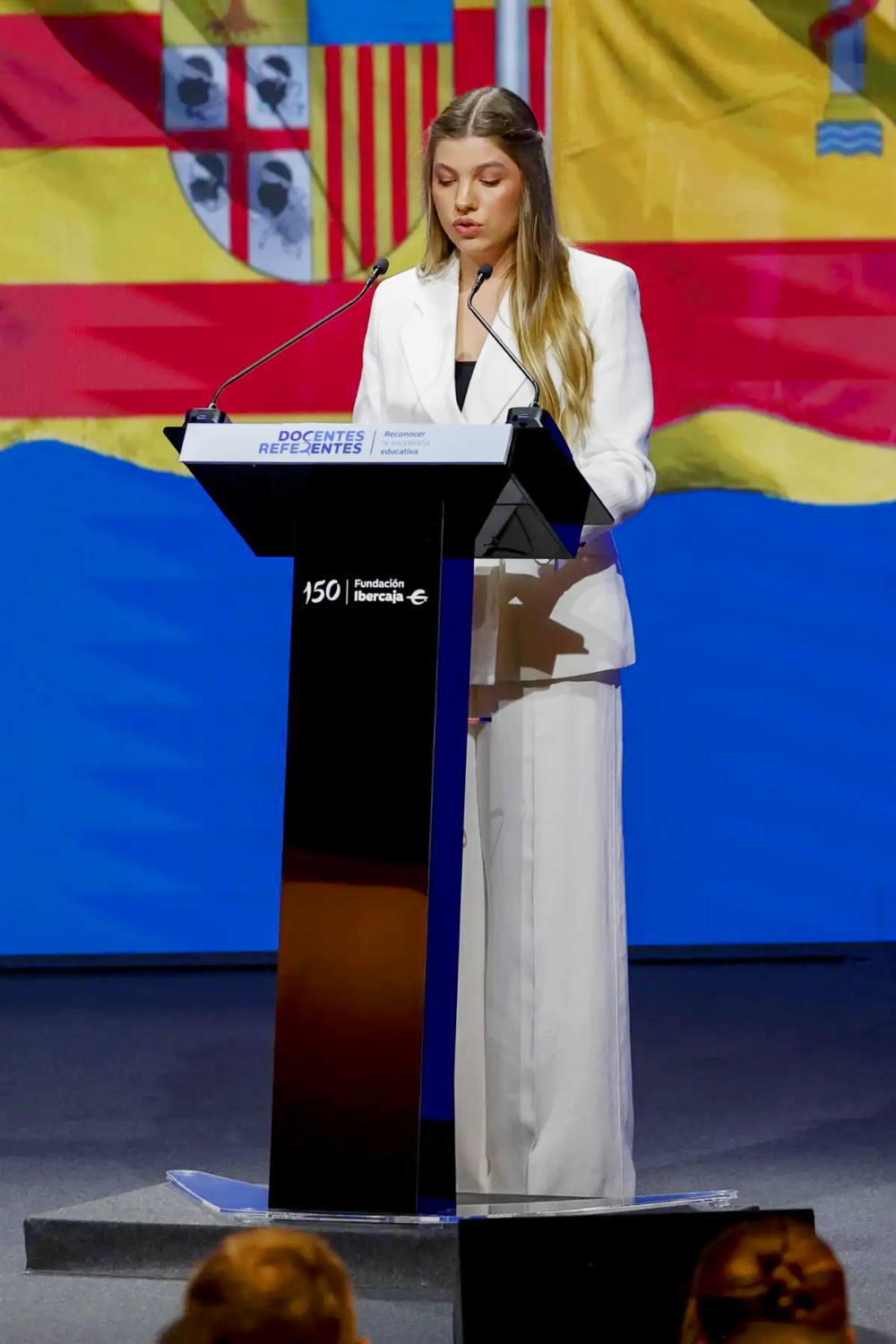
She concluded with a clear defense of the teaching profession, stating that it is one of the best professions in the world and deserves “respect, resources, and full recognition.” She expressed gratitude for being welcomed to make her first public appearance as part of this project, and concluded with a simple “thank you very much,” which was met with a standing ovation.
Despite the understandable nervousness of any debut, it was clear that the Crown Princess now has a new voice with her own style, one that closely resembles her mother’s way of communicating.
Infanta Sofía’s full speech
Good afternoon. I met Baktay when he was 6 and I was 8. It was on those Sunday afternoons, watching movies at home, and it never left my mind. Baktay would sneak some eggs to trade for a half-torn notebook at a dusty market, and the exchange wasn’t even enough to get a pencil.
This little girl was facing a whole world that denied her the right to learn, to knowledge. The film I’m referring to is “Booda Exploded with Shame.” That Afghan girl who fought against everything and everyone because she wanted to be taught. Of course, I had no idea what was happening or what goes on in that country. Baktay made me go—don’t laugh—to my third-grade class with renewed enthusiasm. We’re here today because we care about education, and I want to tell you that as I’ve read more and more about what education means, with all its implications, I’ve come to understand just how vast and incredibly complex it is.
Ibercaja and its foundation have long valued the work of teachers, providing them with tools and ideas, and building networks and a community. This enables Spanish teachers to continue making a significant contribution to the development and progress of our society through education. No one chooses to teach for money or recognition; you know that very well. And we all—even the youngest among us—are aware that there are problems: bullying, a loss of authority, questions about pay, students dropping out, classroom sizes, students with special needs, excessive bureaucracy, funding, and educational inclusion.
It’s worth remembering these three words that local teacher Carlos López Otín attributes to the art of educating, which goes beyond the task of teaching: respect, curiosity, and commitment. Because discussing education, the education system, is far too broad. It encompasses too many things. That’s why in every school, in every classroom, there’s a teacher who, despite the challenges, keeps trying to reach our hearts and minds. One by one, student by student.
In every classroom—whether in the city or the countryside, with newly graduated teachers or seasoned veterans, in schools of various types, whether public, semi-private, or private—there is a teacher who champions that sacred time for learning. There, with calm (if possible), they help us understand the world and form our own perspective on reality. To shape our own hopeful and enthusiastic perspective. And this morning, I saw it right here in La Cogullada. I’ve seen that look in the eyes of our leading teachers. They aren’t just passing on knowledge; they’re teachers who stand alongside their students.
Diego, Clement, Belén, Cristian, Mercedes—congratulations to all of you, truly. And I won’t be the one to talk now about varied methodologies and new pedagogies, the debate on artificial intelligence in education, teaching values, assessment systems, or the relevance of emphasizing skills and abilities more or structuring curricula around the humanities and philosophy. About attention, memory, concentration, and cognitive ability. Put this way, this short list is quite dense.
It seems to me that the teaching profession holds a value and relevance that goes beyond the strategic and touches on the essential. And beyond educational fads. Beyond whether students pay more attention to some random reel than to an explanation in class. Beyond the noise, whether real or imagined, there’s a day in our classroom, in our childhood, that we never forget. A day when, while we still have the capacity for wonder, a teacher says something to us that stays here, captivating us forever.
Many of us believe that yours is one of the best professions in the world, one that deserves much greater appreciation, one that carries significant responsibility, and one that plants the seeds of hope today. And that’s why it deserves respect, resources, and full recognition. These grants and this community of educators, who are embarking on a journey today, are proof of that. And that’s why I’m grateful that you’ve welcomed me, allowing my first public speaking experience to be part of this journey. Thank you very much.